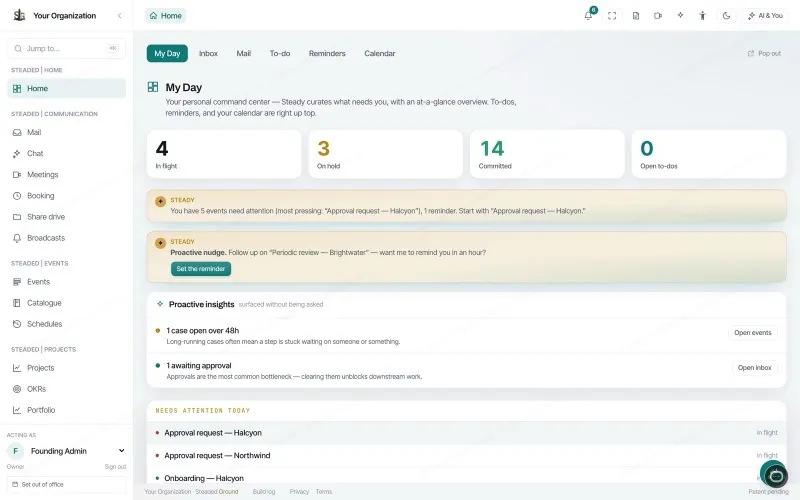
A foundation that audits itself, holding the things we build on top.
Steaded Ground is the first product built on the Substrate — a locked-foundation + configurable-layer architecture where AI-led construction phases produce components that inherit governance, audit, versioning, and reproducibility from the foundation itself.
The substrate is patent-pending. The product is in pre-launch. This site is informational while we get ready — browse the capabilities, functions, and architecture below.
What the substrate guarantees — and why those guarantees are the patent claim.
Reproducibility-grade audit
Every write produces an immutable envelope bound to actor, rationale, prior/new values, and timestamp. The database itself refuses to delete audit rows. Capability invocations bind the exact prompt version, model, inputs, and result — replayable months later.
Unified dispatcher for every AI call
No bypass path. Every capability has both a live AI implementation and a deterministic static fallback that returns the same shape — the app stays functional whether the API key is present or not. Cost, tokens, duration recorded per invocation.
Unified event principle
Every event — domain events, meta-events for onboarding, governance ops, gap-spawned tech events, naming reviews — lives in one table with one shape. Pending isn't a place; it's a where-clause. Status is a column.
Customer extension without forking
Per-tenant capabilities and event-type definitions resolve via NULLS LAST against platform defaults. Customers personalize their version of any record; cross-tenant isolation is RLS-enforced. Vertical packs add domain stores without touching the foundation.
Browse what's on its way.
Every AI call in Steaded Ground goes through one place — a unified dispatcher that records the exact prompt version, model, inputs, and result against the originating event. No bypass path. Every capability has a live AI implementation and a deterministic static fallback that returns the same shape, so the app keeps working whether the API key is present or not.
Classifies every incoming document against the tenant's type registry. Refuses to bin into a junk category — if no type fits, the doc lands in operator triage with AI-suggested new types.
Pulls the schema-defined fields out of any classified doc and binds them onto the document's payload for downstream steps to reference.
Compares two documents and surfaces discrepancies with severity, evidence, and a recommended action.
Composes new documents from event context — engagement letters, status reports, regulatory filings — bound to the originating event for full audit trail.
Classifies an event against active regulations and surfaces which clauses apply, with citation paths.
Pulls the org map and identifies required approvers, notification recipients, and escalation chain — surfaces gaps in crimson when a role is unfilled.
Composes a prose narrative of every change on an event, with evidence references and decision points spelled out.
Drafts stakeholder communications keyed to event state, audience, and risk tier.
Detects duplicates, updates, and conflicts against existing records before an inbound payload is admitted to substrate stores.
Flags suspicious patterns inside an event's activity stream — unusual approvers, off-hours decisions, anomalous spend.
Categorizes failures, exceptions, and edge-case outcomes so they route to the right reviewer with the right context.
Resolves natural-language references ("the Northwind wire from last Thursday") to canonical substrate record IDs.
Reads the in-flight onboarding chat and progressively paints the procedure flow as the operator describes it — live diagram refresh every turn.
Captures a 1-2 sentence narrative for each completed step plus structured outputs bound to context — downstream prompts surface this automatically.
AI replies to step contributions when an operator @-mentions @ai or asks a question on a step thread.
Runs 50 adversarial scenarios against a landed event-type definition to stress-test robustness before it goes live.
The chat-first concierge surface external customers interact with. Action-token vocabulary launches requests, checks status, attaches/requests docs, escalates to a human — all without leaving the chat.
Tests the substrate's own user-facing surfaces. Reports findings as comments anchored on substrate-itself.
Verifies in-flight events still reference real type definitions, capabilities, and stakeholders.
Checks cross-store invariants — ingress lineage, doc payloads matching their classification, audit chain completeness.
Verifies the substrate's claims about itself agree across capability registry, prompt registry, and meta-event registry.
Prompt-driven query layer over the central audit log. Operators ask in plain English; the agent translates into a scoped audit search with citations.
Scores synthetic event runs in the training surface against a gold-standard. Results land in operator-competency signals.
Matthew Mena
Sole inventor on the provisional. Holds the patent rights pending assignment to Steaded. Reach out at matthew@steaded.ai.
Steaded
Builds and ships Steaded Ground. Pre-launch — we're not signing customers yet. When we open access, this page will tell you.